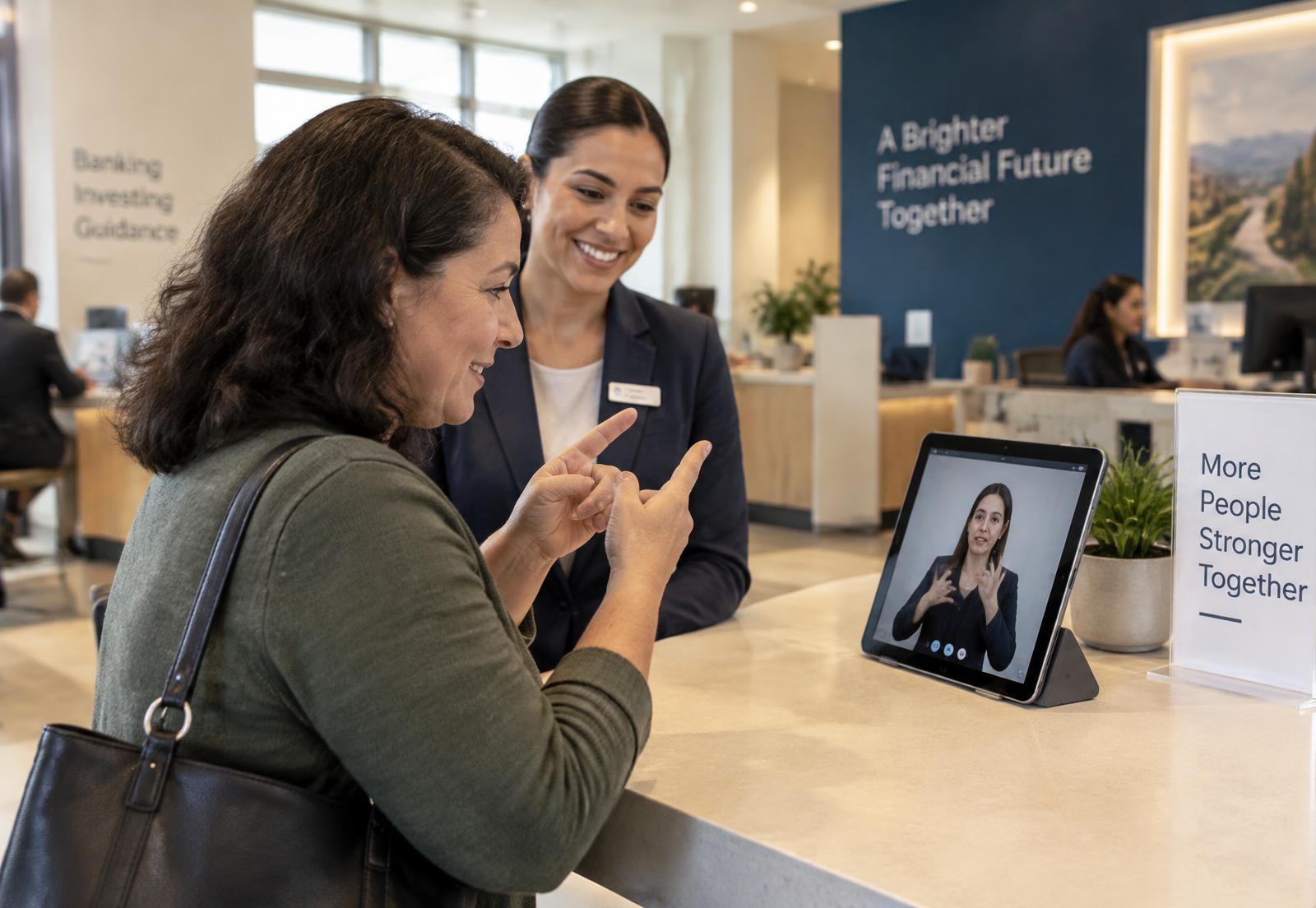
Accessible Customer Service, Built Into Your Business.
Communication Without Barriers.
BeFriend helps organizations transform their customer service channels through integrated accessibility solutions, because every touchpoint in the customer journey shapes the overall customer experience.
bank branches in Colombia where BeFriend service is available
The Business Challenge
Every Customer Deserves to Be Understood.
When communication is inaccessible, routine customer interactions can become difficult for both customers and service teams. BeFriend helps organizations explore practical ways to make communication more accessible for Deaf customers.
Accessible Communication
Support communication between Deaf customers and service teams through virtual sign language interpretation.
Better Customer Experiences
Help make customer interactions more inclusive, respectful, and accessible.
Business-Ready Accessibility
Explore how interpretation can be incorporated into customer-facing operations.
Accessibility & Business Growth
Accessibility Is a Growth Opportunity.
Your next growth opportunity may be a market you’re not fully serving today.
Every business wants to attract more customers, strengthen loyalty, and grow revenue.
Yet some potential customers encounter barriers when accessing products, using services, or communicating with customer-facing teams.
BeFriend helps organizations make customer service more accessible to Deaf customers through virtual sign language interpretation, technology, and operational coordination.
By reducing barriers, organizations can create more opportunities to attract customers, improve customer experiences, encourage repeat business, and earn referrals.
In competitive markets, accessibility can become a meaningful differentiator.
Don’t just serve your market. Expand your reach.
Reach More Customers
Identify potential customer segments that may face barriers when accessing your products or services.
Strengthen Customer Loyalty
Make it easier for customers to access services, communicate with your team, return, and recommend your business.
Build a Competitive Advantage
Integrate accessibility into the customer journey to create more inclusive and effective service experiences.
Let’s explore how accessibility can support your business goals.
U.S. Market Intelligence
The U.S. Hearing Disability Landscape
Explore state-level estimates to understand the population context and identify where accessibility deserves a closer look.
Understanding the population is a starting point for understanding the opportunity. Explore estimates of people reporting a hearing disability across the United States. Use this information to inform accessibility planning, market research, and business outreach.
Population estimates provide context. They do not establish how many people are underserved, use American Sign Language, need an interpreter, or are potential customers.
Estimated civilians with a hearing disability
12,319,000
95% margin of error: ± 71,000 people
% of civilians living in the community
3.7%
95% margin of error: Data unavailable
Not supplied in the source file.
Data year
2024
American Community Survey
Explore a state
Map of the 50 U.S. states and Washington, D.C., colored by published hearing disability percentages of civilians living in the community. Ranges: 2.1–3.0%, 3.1–4.0%, 4.1–5.0%, 5.1–5.9%. Montana and New Mexico share the highest published percentage; small differences may not be statistically meaningful. All estimates and margins are available in the state selector and table.
Source: Annual Disability Statistics Compendium 2026, Table 1.4 (opens in a new tab), published by the University of New Hampshire, Institute on Disability, Center for Research on Disability, based on U.S. Census Bureau American Community Survey Public Use Microdata Sample data for 2024. Estimates are subject to sampling variability and margins of error. The survey asks whether a person is deaf or has serious difficulty hearing. These estimates are not equivalent to the number of people who use American Sign Language or require sign language interpretation.
Percentage denominator: % of civilians living in the community, not the total resident population. Published percentages and margins have not been recalculated. The national estimate is the published total; rounded state counts do not sum exactly to it. Puerto Rico is reported separately by the source and excluded from the state map.
Last verified against source, as recorded in the supplied dataset: .
From Insight to Action
From Population Data to Business Opportunity
Population data provides context. Business opportunity requires a deeper analysis.
For organizations serving Deaf customers, examine communication barriers, relevant customer segments, and service accessibility alongside your locations, customer data, service model, and measurable objectives.
Discuss how BeFriend’s managed service could fit your customer-facing operations. Population estimates alone do not establish customer demand or predict financial returns.
Understand the Market
Assess relevant population estimates and your business’s geographic footprint.
Identify Accessibility Gaps
Evaluate communication barriers across customer-facing channels, physical locations, digital services, and customer support.
Measure Business Outcomes
Establish baseline metrics and track changes in customer acquisition, repeat visits, retention, referrals, and revenue where measurable.
Let’s Identify Your Growth Opportunity
Talk with BeFriend about communication barriers, your service model, and a practical approach to more accessible customer experiences for Deaf customers.
Make accessible customer service part of your business.
BeFriend helps organizations serve Deaf customers through an integrated service combining virtual sign language interpretation, technology, and operational coordination.
One location or an entire organization. A service designed around your operations.
Operational integration
A service designed around how businesses actually serve their customers.
Shared interpreter network
A coordinated model that can support multiple customer locations.
Designed for organizations
From one service point to enterprise-wide operations.
Managed accessibility
Technology, interpreters, and operational coordination in one service model.
Why Organizations Choose BeFriend
More than technology. A managed approach to accessible customer service.
01
Certified Interpreters in ASL and LSC
Certified interpreters in American Sign Language (ASL) and Colombian Sign Language (LSC) support communication, subject to interpreter and service availability.
02
Operational Experience
Since 2019, BeFriend has run virtual interpretation operations in organizations with high customer service demand.
03
A Managed Service
We bring together the technology platform, interpreters, and operational management in one coordinated service — not just a technology tool.
04
Operational Flexibility
We adapt service delivery to each organization’s needs and the characteristics of its service channels.
05
Specialized in Accessible Communication
A service developed specifically to facilitate communication between Deaf people and organizations.
06
Adaptability and Scale
We design the operation around each organization’s service points, coverage needs, and demand levels.
BeFriend
How BeFriend Serves Companies.
Accessible customer service. Across every channel.
From physical service locations to contact centers and digital channels, BeFriend helps organizations integrate accessible communication into their customer service operations.
One managed service. Multiple customer touchpoints.
On demand
BeFriend — In-Person Service
In-Person Customer Service
On-demand virtual interpretation at offices, stores, restaurants, and medical centers.